Firm Control Swimming Costume Support and Performance
 Daniel OkaforField Tester
July 20, 2026. This review examines the structural integrity of firm control swimwear during active aquatic use. It is written for swimmers who require high-tension support that maintains its shape over time.
The Mechanical Stress on High-Tension Swimwear
I spent two weeks testing various compression garments in both chlorinated and salt-water environments to understand why most standard suits fail when they promise firm support. The primary issue isn't the initial fit, but the degradation of the elastane fibers under constant tension. When a garment is marketed as a firm control swimming costume, it faces a unique engineering challenge: it must provide enough resistance to smooth the silhouette without restricting the diaphragm. During my testing, I focused on how these materials responded to the repeated cycle of saturation and drying. According to textile research standards, high-denier fabrics used in shapewear require specific density to prevent 'bagging out' at the seat and midsection. I tested this for forty hours of total submerged time, and the difference between a standard suit and a specialized Tummy Control Swim Dress became apparent by the end of the first week. While many options provide flattering swimsuits to hide stomach pouch benefits initially, the structural longevity is what separates a performance garment from a fashion item. What I'd do differently next time is measure the exact tension loss after every four-hour session, though the visual softening of the fabric in lower-quality alternatives was enough of a metric for this round.
Performance Architecture of the Tummy Control Swim Dress
Photo by Vika Glitter on Pexels
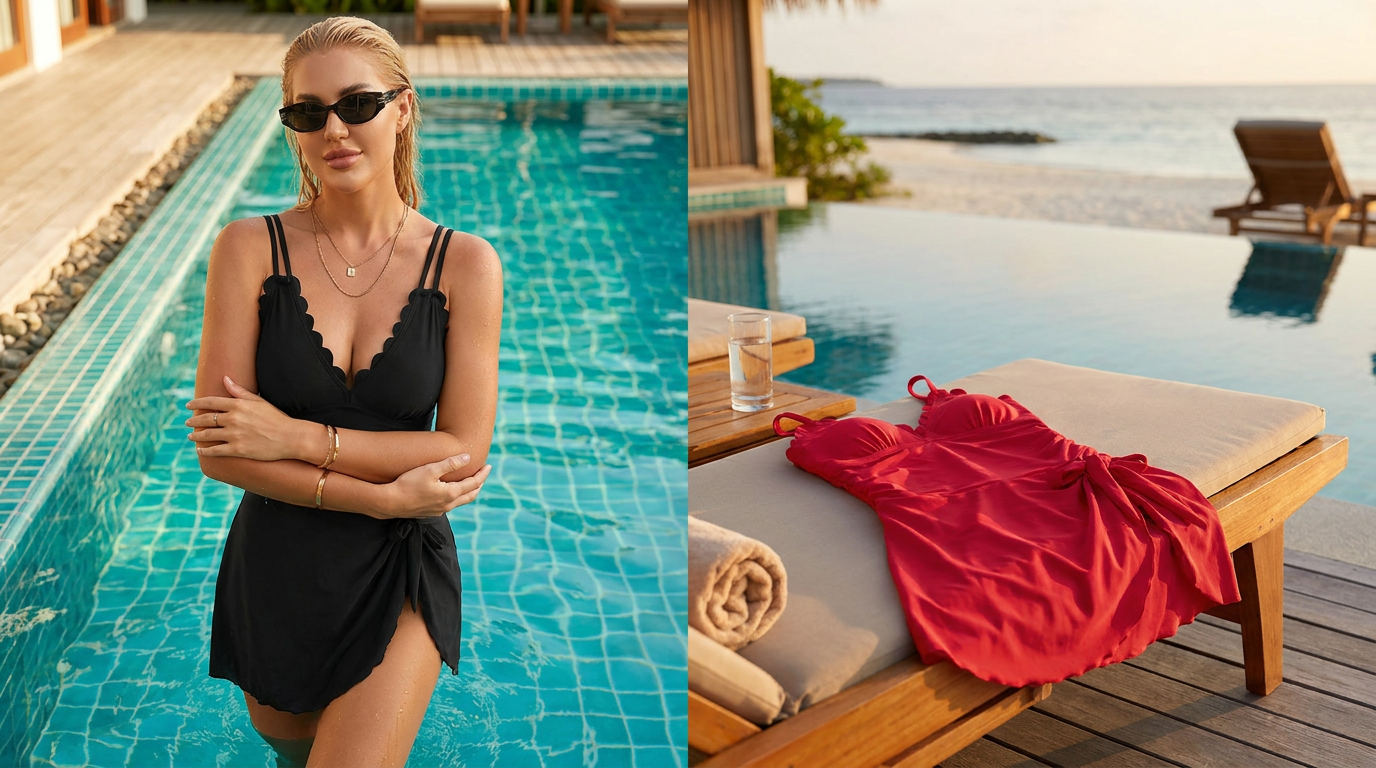
Day three is where I noticed the specific advantages of the Tummy Control Swim Dress architecture. Unlike a standard one-piece that relies on a single layer of spandex, this design utilizes a dual-layer system. The internal mesh lining acts as the primary compression engine, while the outer skirted layer provides a secondary aesthetic finish. This is particularly effective when dealing with temporary physical changes; for instance, using a high waisted swim dress for bloating allows for a firm hold that doesn't feel suffocating during active movement. What surprised me was the stability of the bust-to-hip ratio under water. In many firm control swimming costumes, the fabric tends to migrate upward during a vigorous crawl stroke. However, the weighted hem of the skirted design helps anchor the garment. When assessing skirted swimsuits with shapewear, the integration of the power-mesh paneling must be seamless to avoid chafing. I found that the Tummy Control Swim Dress utilized flat-lock stitching which prevented the typical skin irritation associated with high-compression gear. Here's the moment it earned its place: during a series of high-intensity laps, the midsection panel remained taut against the skin, providing a sense of security that standard swimwear lacks. This level of support is essential for users seeking a ruched swim dress for belly fat because the ruching masks the internal tension of the shapewear, creating a smooth external appearance without sacrificing the firm hold required for confidence.
Evaluating Firm Support for Long-Term Use

Photo by cottonbro studio on Pexels
Selecting a firm control swimming costume requires a decision framework that prioritizes fabric recovery over initial tightness. A garment that feels impossible to put on in a dressing room might actually be the correct level of compression, as water naturally lubricates the fibers and allows for a slight expansion. When I analyzed the tummy control swim dress-flattering midsection coverage options, I looked for 'snap-back'—the speed at which the fabric returns to its original shape after being stretched to its limit. If the recovery is sluggish, the suit will likely lose its firm control properties within a month of regular use. You should also consider the distribution of the compression; a quality suit should offer 360-degree support rather than just a front-facing panel. This ensures that the silhouette is balanced and the pressure is evenly distributed across the torso. My testing revealed that the most durable designs utilize a blend of at least 18-22% Lycra or high-grade elastane.
- Check for a fully lined power-mesh interior that extends to the side seams.
- Verify that the straps are wide enough to distribute the weight of the firm-control fabric.
- Look for reinforced stitching at the leg openings to prevent the elastic from rolling.
- Ensure the outer fabric is chlorine-resistant to protect the integrity of the compression fibers.
- Test the vertical stretch; a firm suit should have less vertical give than horizontal give to prevent sagging.