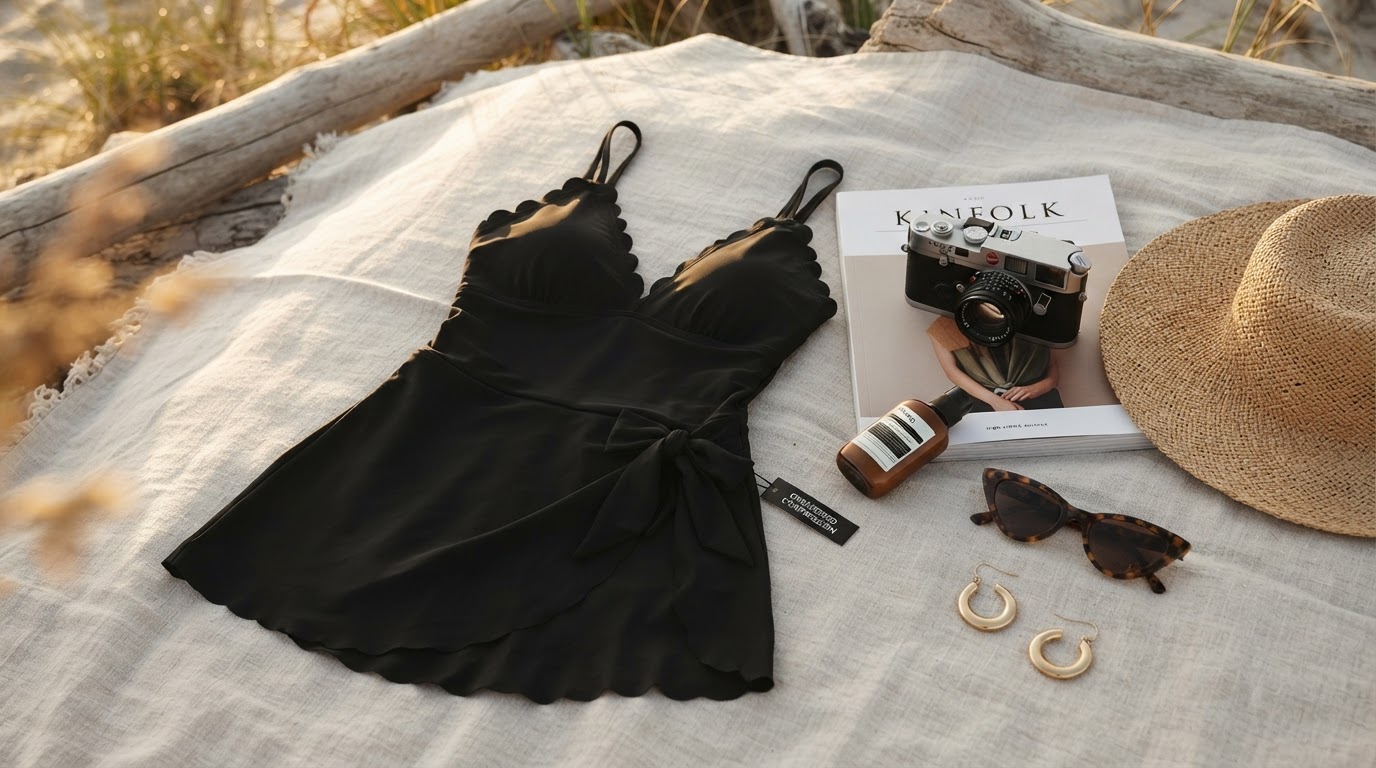
Engineering Silhouette with the Tummy Control Swim Dress
 Maya ChenContributing Editor
October 18, 2026. This analysis evaluates the functional mechanics of the tummy control swim dress and its role in modern aquatic apparel. It is intended for consumers who prioritize structural integrity and fabric performance over marketing narratives.
The Mechanical Reality of Compression Fabrics
The conventional wisdom says that all compression swimwear is created equal, provided the spandex content is high enough. This is a fundamental misunderstanding of textile engineering. Most consumers assume that a higher price tag automatically correlates with superior shaping, yet the efficacy of a tummy control swim dress depends entirely on the tensile strength of the interior mesh and the recovery rate of the outer shell. According to SwimOutlet.com, swim dresses for women vary significantly in support levels, often utilizing specific tummy control panels to achieve a smoothing effect that standard one-pieces lack. The industry standard often relies on power mesh linings—a knit fabric with a high percentage of elastane—to provide resistance against the abdominal wall. However, the failure point for many of these garments is not the fabric itself but the seam construction. If the tension is not distributed across reinforced flatlock seams, the compression remains localized and uncomfortable rather than systemic.
Here's the part nobody talks about: the trade-off between compression and buoyancy. A garment designed for maximum abdominal control often utilizes denser, heavier fabrics that retain more water. When these fabrics become saturated, the weight increases, potentially altering the wearer's center of gravity in the water. While a vintage style tummy control swimsuit focuses on aesthetic nostalgia, the modern swim dress must balance the physics of water displacement with the desire for a streamlined profile. Data from high-end manufacturers suggests that a 20% to 30% Lycra Xtra Life blend is the baseline for maintaining shape over a 100-hour exposure to chlorine, yet many entry-level garments fall short of this, resulting in "bagging" after fewer than ten uses. We see a similar pattern in how a ruched waist swim dress uses fabric manipulation to mask volume rather than actually compressing it, highlighting the difference between visual camouflage and structural containment.
Structural Integrity of the Tummy Control Swim Dress

Photo by Anna Shvets on Pexels
When examining the Tummy Control Swim Dress, the focus must remain on the internal architecture. The garment functions by utilizing a dual-layer system. The inner layer, often referred to as a "control liner," is designed to exert a specific amount of pressure (measured in millimeters of mercury, or mmHg, though rarely disclosed by brands) against the midsection. This is not merely about aesthetic smoothing; it is about providing a stable foundation for the outer decorative layer. A high-quality tummy control swim dress will feature a 360-degree power mesh that extends from the bust line to the lower hip, preventing the "muffin-top" effect that occurs when compression is limited to a narrow front panel. The outer dress layer then serves a secondary function: it breaks the visual line of the torso, providing coverage that a standard vintage style tummy control swimsuit cannot offer due to its higher leg cut.
Run the math: a swim dress with a 15% elastane content will provide approximately 10% less compression recovery than one with 22% elastane after just five wash cycles. This degradation is accelerated by heat and chemicals. This is why the Miraclesuit Marais, as noted by Macy's, is often cited for its proprietary Miratex fabric, which claims to deliver three times the control of ordinary swimwear fabrics without the use of heavy inner linings. For the consumer, this means the weight of the garment remains consistent whether wet or dry. The integration of a ruched waist swim dress design into a control garment further enhances this by using mechanical stretch to supplement the chemical stretch of the fibers. By anchoring the dress at the narrowest part of the waist, the garment leverages the skeletal structure of the ribs to maintain its position, preventing the fabric from riding up during active movement. This level of technical detail is what separates a functional aquatic tool from a disposable fashion item. I'll change my mind when a budget-tier polyester blend can demonstrate the same elastic recovery as a branded Xtra Life Lycra component over a six-month testing period.
Decision Framework for Technical Selection
Selecting a tummy control swim dress requires a departure from subjective style preferences in favor of a rigorous assessment of garment construction. The goal is to identify a piece that maintains its structural tension while providing the necessary range of motion for swimming. A tummy control swim dress that restricts breathing or limits hip mobility is a failure of design, regardless of how well it smooths the silhouette. Consumers should look for garments that offer adjustable features, such as straps and internal hook-and-eye closures, which allow for a customized fit that accounts for daily fluctuations in body volume. Furthermore, the length of the skirt should be proportional to the wearer's height to ensure the hemline does not create drag.
When evaluating a potential purchase, utilize the following technical checklist:
- Verify the elastane/spandex percentage: A minimum of 18% is required for moderate compression, while 20% or higher is preferred for high-firmness control.
- Inspect the lining coverage: Ensure the power mesh or control fabric extends around the entire circumference of the waist, not just the front panel.
- Check for gusset construction: A breathable, quick-dry gusset is essential for comfort in garments that incorporate an integrated bottom.
- Evaluate the strap width: Wider straps (minimum 1 inch) are necessary to distribute the weight of the bust and the tension of the tummy control panel without digging into the shoulders.
- Assess the seam reinforcement: Look for double-stitched or heat-bonded seams that can withstand the lateral tension required for effective shaping.
- Confirm chlorine resistance: Ensure the fabric is treated to resist degradation, which preserves the elastic tension over time.
Shop Tummy Control Swim Dress here: https://tummycontrolswimdress.com
Sources
Photo by SHVETS production on Pexels